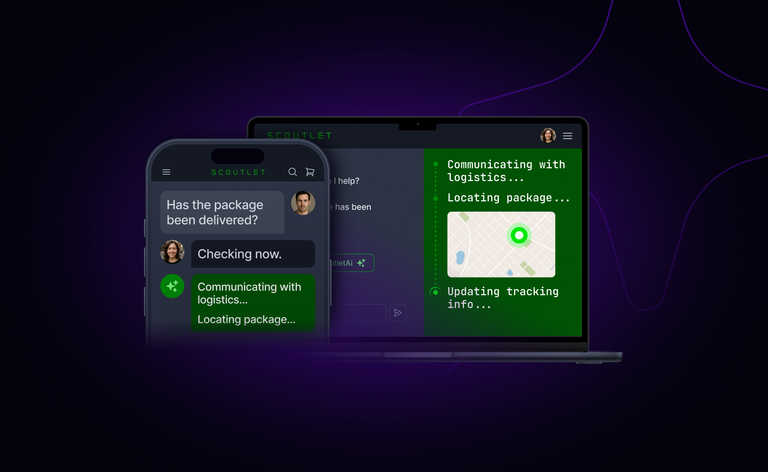
We're entering a new era of anticipatory customer experience – one that's not just reactive, not just responsive, but truly predictive. In this new model, systems don't wait for friction to appear; they recognise signals early and step in before the user ever feels a slowdown or moment of uncertainty. The bar has shifted: customers now expect brands to predict their needs and act before friction even surfaces. It's a fundamental rewiring of the relationship between companies and the people they serve.
This shift toward predictive customer experiences isn't hypothetical. Anticipatory experiences are happening now, powered by realtime data infrastructure that moves companies from playing catch-up to staying ahead. Think of it as the Age of Anticipation – where realtime signals, reliability, and adaptability form the core of modern CX design.
Anticipatory CX isn't magic, it's just realtime infrastructure done right.
So, if you're building next-generation CX or AI-powered agentic systems, this article outlines the architectural groundwork required to make anticipation real.
What is anticipatory customer experience?
Anticipatory customer experience uses realtime data infrastructure to predict and address customer needs before friction occurs. Unlike reactive support that waits for problems, anticipatory CX leverages continuous data streams, event-driven patterns, and predictive signals to intervene proactively—turning unknowns into reassurance.
Why realtime infrastructure matters for CX: Realtime infrastructure enables the continuous flow of customer signals needed for prediction. Without it, systems rely on stale, batch-processed data that kills foresight. Companies like Doxy.me and HubSpot use realtime platforms to anticipate confusion, delays, and churn risk before customers experience frustration.
From reactive to anticipatory: Why realtime data infrastructure powers predictive CX
Anticipation starts with having the right information at the right moment. But stale, batch-processed data kills foresight. Prediction requires fresh, realtime signals flowing continuously through your systems.
Consider Doxy.me, a telehealth platform that's moved beyond just facilitating video appointments. They're building "teleconsent" features where healthcare providers walk patients through consent forms in real time. As the patient reads, fills in fields, and types responses, the provider sees every change as it happens – no refresh required, no lag, no wondering if the patient is stuck. The system anticipates confusion before it becomes abandonment.
"The more that I can get my team to focus on healthcare business logic and less to focus on infrastructural data synchronisation, the better," explains Heath Morrison from Doxy.me. "Anything that provides higher level APIs to get us more in that space – and not be specialised in the stuff you guys should specialise in – is appealing and valuable to us." Read how Doxy.me rebuilt their realtime stack with Ably.
Retailers are doing similar work, spotting churn risk in realtime and intervening with targeted offers or support before the customer clicks away. Financial services companies are shifting from asking "what happened?" to "what's about to happen?" These aren't reactive fixes. They're anticipatory moves that change outcomes – but only when the underlying data infrastructure can keep pace.
Realtime infrastructure like Ably's makes this possible – it's the unseen layer that ensures systems receive the continuous stream of signals they need to predict accurately, without lag or data loss.
Industries using anticipatory CX
Healthcare: Telehealth platforms use realtime infrastructure to anticipate patient needs, showing "doctor joining now" before patients wonder if something's wrong.
Financial Services: Banks predict fraud patterns and alert customers to unusual activity before money moves.
Retail: E-commerce platforms spot abandonment signals and intervene with targeted offers before checkout failure.
Logistics: Delivery services flag delays and update ETAs before customers start refreshing tracking pages.
Building trust through realtime customer engagement: The infrastructure foundation
Trust is built in moments of uncertainty. And anticipation? It turns unknowns into reassurance.
Think about the last time you booked a rideshare or waited for a delivery. The difference between a company that leaves you guessing and one that proactively updates you – "your driver is two minutes away," "slight delay, new ETA: 3:47pm" – is the difference between anxiety and confidence. Realtime anticipation doesn't just inform, it reassures.
Telehealth platforms have figured this out. When patients see "doctor joining now" before they've even begun to wonder if something's wrong, it changes the entire experience. Logistics companies that flag delays before customers start refreshing tracking pages are doing the same thing: reducing friction before it becomes frustration.
But there's a flip side: when realtime systems fail, trust erodes faster than it built up. A phantom notification, a delayed update, an inaccurate prediction – these aren't just technical hiccups. They're credibility problems. Reliability isn't a nice-to-have, it's the foundation. When customers cite Ably's five-plus years without a global outage, they're not celebrating uptime for its own sake. They're describing the baseline that makes anticipation possible at scale. View Ably's live uptime status.
Ably exists to be that foundation. The reason trust can scale across millions of interactions, without companies needing to worry about the underlying infrastructure failing at the worst moment.
Core technologies behind anticipatory CX
Future-proofing customer experience: Event-driven architecture for anticipatory CX
To anticipate effectively, your CX stack needs to evolve as fast as your customers' expectations do. Rigid, monolithic architectures can't keep up with new signals, emerging channels, or changing customer behaviors. The future belongs to composable, event-driven systems.
Doxy.me's evolution illustrates this perfectly. They built their realtime features organically – using PubNub to handle presence detection and state synchronisation, all ephemeral data that disappeared after each session. But as they planned their next phase, they hit a wall: they needed persistence. The ability to decouple patient workflows from video calls, support richer collaboration, maintain state across sessions, and plug in new capabilities without rebuilding their entire stack. They prototyped with Convex and loved the developer experience, but needed production-grade infrastructure that could slot into their Node/TypeScript/Postgres/AWS environment.
Event-driven architectures make this kind of evolution possible. You can layer in predictive capabilities, plug in new communication channels, or add analytics tools – all without tearing everything down and starting over. One enterprise CX leader described it this way: "We used to dread adding new functionality. Now we think in terms of what events we need to listen for and what actions we want to trigger. It has completely changed our velocity."
Ably enables this kind of interoperability – CRMs, chat systems, analytics tools, customer-facing applications all publishing and subscribing to customer events in real time. WebSockets and pub/sub patterns ensure consistent, low-latency communication across every channel, without developers having to reinvent transport logic for each integration. It's the connective tissue that makes anticipatory systems work at scale.
But more moving parts do mean more complexity. Companies need governance frameworks and resilience planning to ensure their adaptive architectures don't become fragile ones. The ones succeeding here aren't necessarily the ones with the newest tech – they're the ones who've built systems that can absorb change without breaking.
The Age of Anticipation is composable. Adaptive, event-driven architecture is what makes foresight scalable.
How to implement anticipatory CX
1. Establish realtime data infrastructure – Replace polling with streaming architecture for continuous signal flow
2. Implement event-driven pub/sub patterns – Enable loosely coupled systems that respond to customer signals
3. Build predictive models using continuous data – Layer AI/ML on top of realtime streams for pattern recognition
4. Create proactive intervention workflows – Design automated responses to predictive signals (offers, alerts, support)
5. Monitor reliability metrics rigorously – Track latency, uptime, message integrity to maintain trust at scale
What makes this different
Most CX discussions focus on speed (faster responses, quicker resolutions.) But anticipation goes deeper. It's about infrastructure that doesn't just move data quickly, but does so reliably enough to build trust and flexibly enough to adapt as expectations evolve. Explore Ably's four pillars of dependability.
Realtime infrastructure is the hidden enabler. It's what makes customer care feel effortless, predictive, and ultimately, more human. Not because it replaces human judgment, but because it removes the friction that gets in the way of delivering exceptional care.
The companies winning in the Age of Anticipation aren't the ones with the flashiest technology demos. They're the ones who've built the unglamorous, reliable, adaptive infrastructure that makes anticipation possible at scale. They've realised that foresight isn't magic – it's architecture.
Business impact of anticipatory customer experience
- 52% of consumers stopped using brands after bad experiences – making proactive, anticipatory CX non-negotiable (PwC 2025 Customer Experience Survey)
- 65% cost reduction achieved by Doxy.me through realtime infrastructure that prevents issues versus fixing them reactively
- 61% of CX leaders deliver proactive communications using AI, while only 6% of laggards do, creating a significant competitive gap (Cisco research)
- 5+ years without a global outage – Ably's proven track record demonstrates the reliability required for maintaining trust at enterprise scale
- 40% of companies plan to increase investment in predictive instant experiences in 2025, signalling industry-wide shift to anticipatory models
Three pillars of anticipatory CX
1. Realtime data streams – Fresh, continuous signals flowing through your systems without latency or data loss
2. Reliability at scale – Infrastructure trusted to maintain consistency across millions of interactions, measured in years of uptime
3. Adaptive architecture – Event-driven systems that evolve with customer expectations without requiring rebuilds
Ready to build anticipatory experiences?
Ably's realtime platform delivers the continuous data streams and event-driven patterns your systems need to anticipate customer needs, with the reliability required to maintain trust at scale.
Six-plus years of 100% uptime. Sub-6.5ms message delivery latency. Built-in message integrity guarantees.