
Most companies talk about being “AI-first.” At Ably, we decided to actually become one. We build realtime infrastructure for AI applications. To do that credibly, we need to live and breathe AI ourselves – not just in our product, but in how we work every day.
A year ago, we began a company-wide push for AI adoption. This post breaks down how we did it: the pillars, the tooling, the MCP advantage, the early mistakes, the wins across engineering, marketing, sales, and finance, and the cultural momentum that turned a mandate into a mindset.
Building an AI-first company culture
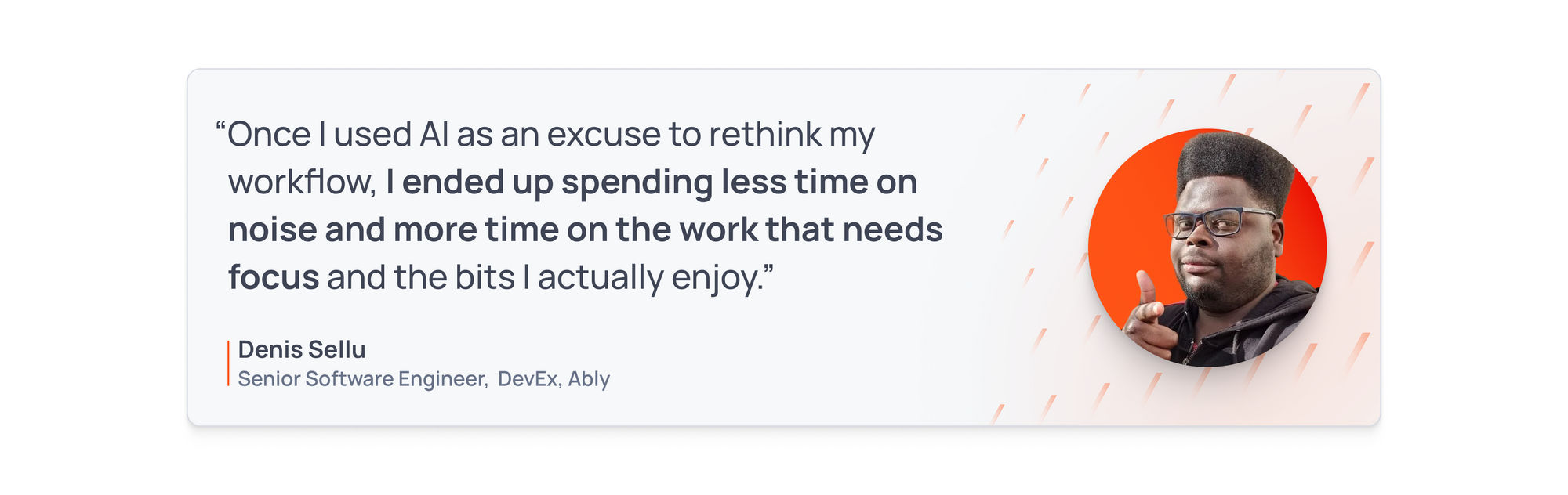
When Jamie Newcomb, Ably's Head of Product Operations, began championing internal AI adoption, the approach was straightforward: everyone at Ably should explore how AI could make them more effective. No exceptions.
"We might want to tone down the language," Jamie admits with a laugh, "but it really is mandated. Everyone at Ably should be using AI to see how they can make themselves more effective. But it's not just about doing things faster. It's about doing things you couldn't do before. The goal is to shift the mindset, where people stop asking 'can AI help with this?' and start assuming it can, then push further: what's now possible that wasn't?"
Today, that mandate has evolved into something far more organic. A company-wide culture where AI isn't just accepted, it's expected.
For a company processing 2 trillion operations monthly, this isn’t about following trends, it’s about credibility. It's about walking the walk. To build AI Transport that developers can trust for agentic workloads, we need firsthand experience of how AI performs in real operational environments, both the advantages and the pitfalls.
Three pillars of successful AI adoption
Ably's approach to AI rests on three interconnected pillars:
- Internal AI adoption and enablement: Integrating AI into workflows and processes across every team to enhance capabilities and drive productivity improvements. The goal isn't just providing tools, it's automating repetitive, time-consuming tasks so people can focus on strategic thinking and creative problem-solving.
- AI developer experience: Using AI to make Ably's platform more discoverable and easier to use for developers. This means AI-enhanced documentation, intelligent tooling, and optimized SDK experiences, empowering developers to build real-time products faster with the help of LLMs. The goal is to position Ably as essential infrastructure for real-time user experiences powered by AI.
- AI product enhancement: Making proactive, explicit efforts to understand AI use cases where Ably delivers value, determining what we need to enable those use cases, and ensuring those capabilities are part of our roadmap. This pillar is about building infrastructure informed by real customer needs, both known and yet to be discovered.
"My main role is about process efficiency in product engineering," Jamie explains. "And that naturally extended to AI adoption. We believe there are significant productivity improvements we can make if everyone adopts AI thoughtfully across the company."
These pillars aren't separate initiatives. They're a unified strategy.
Internal productivity adoption teaches us what works in practice. Developer experience ensures we're making Ably discoverable and easy to use for the growing number of developers building with AI. And AI product enhancement ensures we're building infrastructure informed by real customer needs, not just theory. This article focuses primarily on the first pillar, but the three are deeply connected. What we learn from using AI internally shapes how we build for developers using AI externally.

The MCP advantage
Perhaps the most significant internal development has been Ably's adoption of the Model Context Protocol (MCP), built over the summer of 2025.
"The Ably MCP connects all our internal tools together," Jamie explains. "It lets people access data across systems via AI assistants. Building this and seeing it genuinely change how people work has been incredibly rewarding."
What started as an experiment to see what was possible has grown into a company-wide platform that's now critical to daily workflows, integrating 15+ services through over 140 tools. Engineers can check CI build status and debug workflow failures without leaving their conversation. Product managers search across Jira issues, GitHub PRs, and Slack threads in a single query. Sales teams pull Gong call transcripts and HubSpot contact history to prepare for customer meetings. The breadth is significant: GitHub, Jira, Confluence, Slack, HubSpot, Gong, Jellyfish, Metabase, PagerDuty, GSuite and more, all accessible through natural conversation.
Before MCP, every AI interaction started from zero, engineers manually explaining Ably's infrastructure, marketers pasting in brand guidelines, constant context-switching that made AI feel like more work rather than less.
Now when an Ably employee opens Claude, they're not starting from scratch. Through MCP, they have immediate access to:
- Shared context and prompt library
- Company knowledge and documentation
- Ably's tone of voice guidelines and style guides
- Live data from internal tools and systems
Instead of "Here's what Ably is, here's our tone of voice, now help me write this email," it becomes simply: "Help me write this customer email about latency improvements." The AI already knows.
Scaling to 140+ tools created its own challenge: context limits. Ably solved this with a tool registry that lets the AI discover only what it needs for each task, keeping interactions lean and responsive.
"That context library is really important," Jamie emphasises. "The prompts for critical workflows (like our ICP matching) are all version controlled. When something needs adjusting, it's not about AI being wrong. It's about iterating on what you're asking the AI to do."
The platform continues to evolve based on team feedback. When engineers noticed they were dropping out the terminal to check GitHub Actions builds, new workflow tools were shipped within hours. Claude Code is used heavily to maintain and extend the MCP itself, with Claude's Agent SDK integrated throughout the development workflow. Using AI to build AI tooling is a big part of why the velocity is so high. That responsiveness, treating internal AI tooling as a living product rather than a one-off project, reflects how deeply AI has become embedded in Ably's operating culture.
Jamie spoke at length with Jellyfish on how Ably moved beyond data retrieval to unlock real analysis and insights through MCP, and you can read the full article here.
AI tool selection
When Ably first encouraged company-wide AI adoption, the approach was deliberately open-ended. People experimented with ChatGPT, Claude, and workflow orchestration tools like N8N, Zapier, and Relay.
"We've settled on Claude for our primary AI, particularly Claude Code for engineers, but people have the freedom to use whatever works best for them," Jamie says. "If someone has a strong case for a different tool, that's fine. We're not prescriptive about it."
Everyone at Ably has access to Claude for day-to-day work, whether that's drafting documents, thinking through problems, or exploring ideas. For workflow automation, Relay emerged as the orchestration layer, handling the multi-stage pipelines that power lead enrichment, ICP scoring, and sales alerts. The combination of Claude for reasoning and Relay for orchestration has become Ably's default stack, though teams remain free to experiment.
This flexibility matters, especially given Ably's positioning around AI Transport. "We can't just say 'use Claude' when we're building infrastructure that works with any LLM provider," Jamie notes. "We need to show that our approach works regardless of which AI you're using."
Results by team
Engineering
All engineers now use Claude Code for agentic coding, but the workflows vary based on the task.
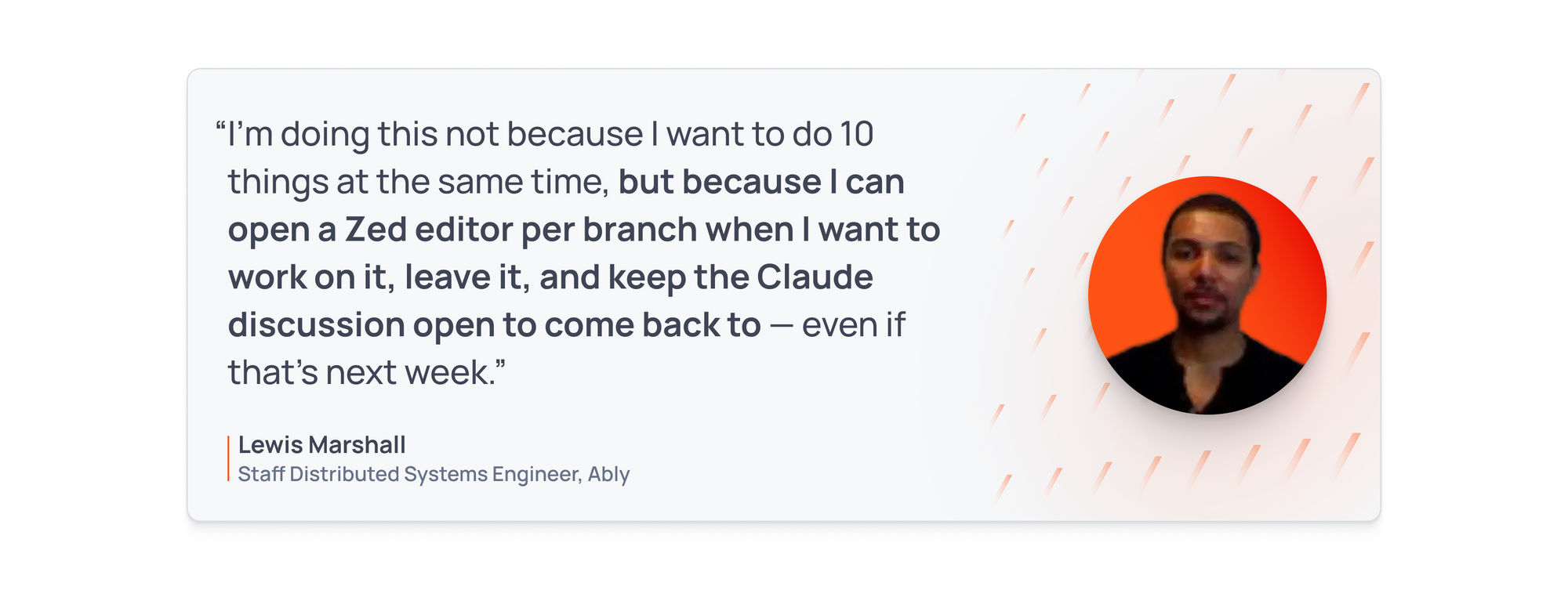
For narrow, well-defined tickets, Claude can often one-shot a solution. Engineers point it at the relevant files, describe what they want, and use test-driven development as a guardrail. Claude writes the test first, sees it fail, writes the implementation, and confirms the test passes. For larger tasks, the approach is more iterative: Claude generates a plan as a markdown file, the engineer reviews and refines it, then kicks off implementation in a fresh context with the plan as input.
Discovery is another common use case. Engineers ask Claude questions about the codebase, "where does X get used?", "how does a message get from acceptance to being broadcast out to clients?", using it as a way to navigate complex systems without reading through thousands of lines of code.
The Ably MCP bridges the gap between documentation and code. Engineers pull context from Confluence docs, have Claude synthesise summaries, and feed those into coding sessions, turning scattered documentation into usable implementation context. Some are experimenting with Claude Code running asynchronously in the browser, queuing up tasks from a phone and reviewing the work later.
Beyond individual workflows, Claude is integrated into the development pipeline itself. Claude's Agent SDK is connected to GitHub to generate implementation context, review PRs, and fix CI issues before code reaches production. When a PR goes up, AI reviews it for obvious issues first, then engineers review it as they would any other colleague's work.
One principle remains constant: a single human author owns every PR, regardless of how much was AI-generated. The practice of engineering judgment, knowing what to accept, what to push back on, and what to rewrite, is still the job.

Marketing
The Marketing team wanted to spend more time shaping the narrative and shipping campaigns, not doing repetitive admin. There are always multiple activities in flight, each needing planning, research, execution, reporting, and analysis. That's where AI has been a huge productivity lever: the team has adopted it to streamline the "admin" layer so they can increase both output and quality without adding headcount.
Today, the team uses a small stack of AI tools across the lifecycle. They analyse Gong calls to accelerate market research and tighten messaging and positioning. They use Claude to pull and synthesise data from multiple sources to scope and validate content opportunities faster. They also automate lead validation and categorisation for sales follow-up, enriching contact and company data so the first human touch starts from context, not guesswork. And they map the customer journey with attribution, using AI to connect what prospects do pre-signup to intent signals, so they can prioritise the right audiences and double down on what's actually working.
For example lead qualification that used to take hours, is now a multi-stage AI pipeline that runs automatically on every signup. The system researches companies across 6+ data sources (Crunchbase, LinkedIn, SEC filings, PitchBook), extracts structured data, scores against 8 ICP criteria, classifies personas, and routes alerts to Slack with tier assignments and recommended actions – all before anyone on the team sees the lead.
"Marketing used to spend considerable time on this," Jamie recalls. "Now the first time they see a lead, it already has a confidence-scored ICP assessment, enriched company data, and suggested next steps."
Sales
New lead assignment uses multi-signal analysis (employee count, funding raised, revenue for public companies) to automatically route accounts to Commercial, Enterprise, or Strategic segments. For qualified leads, AI generates personalised email sequences based on the ICP analysis, tailoring messaging to the prospect's industry, technical challenges, and relevant customer references.
For existing customers, AI monitors self-service accounts against usage limits, surfacing expansion opportunities when customers approach thresholds and flagging critical capacity alerts that need immediate outreach. Relay handles the orchestration across all workflows.
Finance
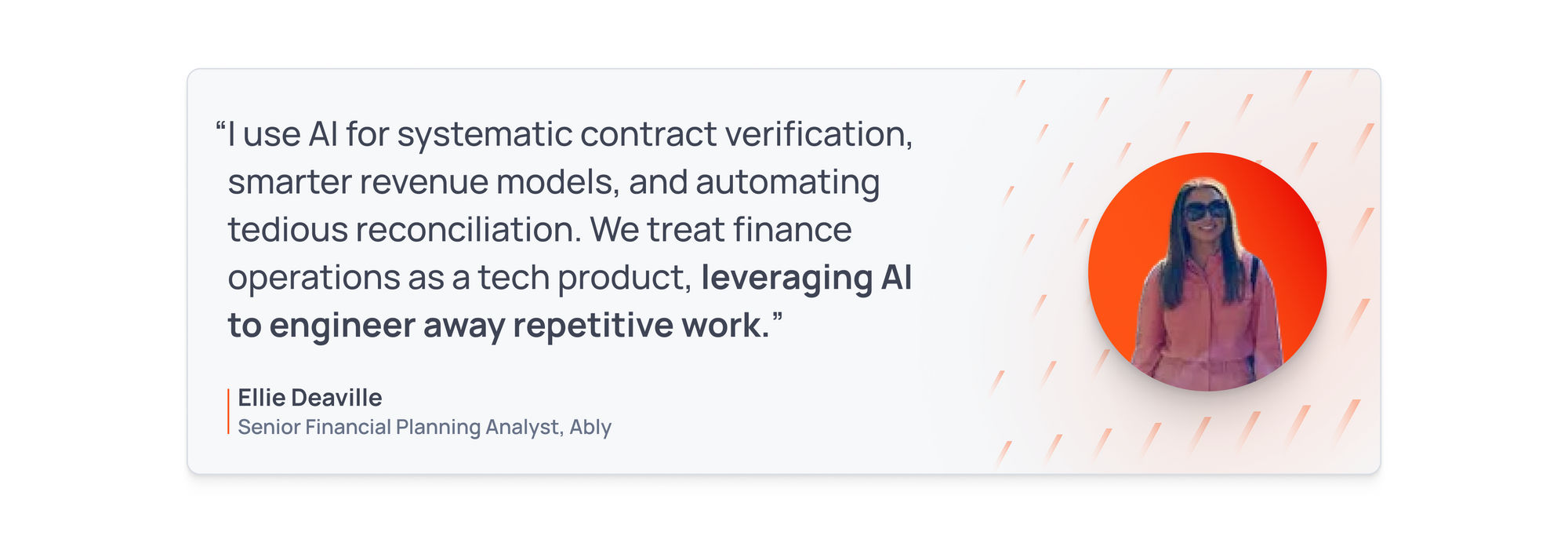
Finance operations at Ably are treated like a tech product, using AI as a force multiplier to engineer away repetitive work.
The team systematically verifies contracts, builds smarter revenue models, and automates reconciliation work. A recent hackathon project eliminates thousands of monthly clicks in the Stripe-to-Xero process, the kind of repetitive work that most finance teams wouldn't know where to start automating.
They use Ably's MCP to retrieve data from Xero, then create and update sheets directly through Claude, turning what would be manual exports and data entry into conversational requests. It's a small example of how the platform extends beyond engineering and into every corner of the business.
The cultural shift
Creating an AI-first culture isn't just about providing tools – it's about enablement, support, and honest assessment of where you are versus where you're headed.
We run AI drop-in sessions every Friday where team members can bring questions, share what they've built, or explore new ideas. An internal Slack channel serves as a continuous stream of AI experiments, wins, and collaborative problem-solving.
"When Charlotte [Delivery Manager] and I approach teams, we don't even talk about AI initially," Jamie reveals. "We ask: what are your repetitive processes? Once teams understand their processes, then you can start the AI conversation."
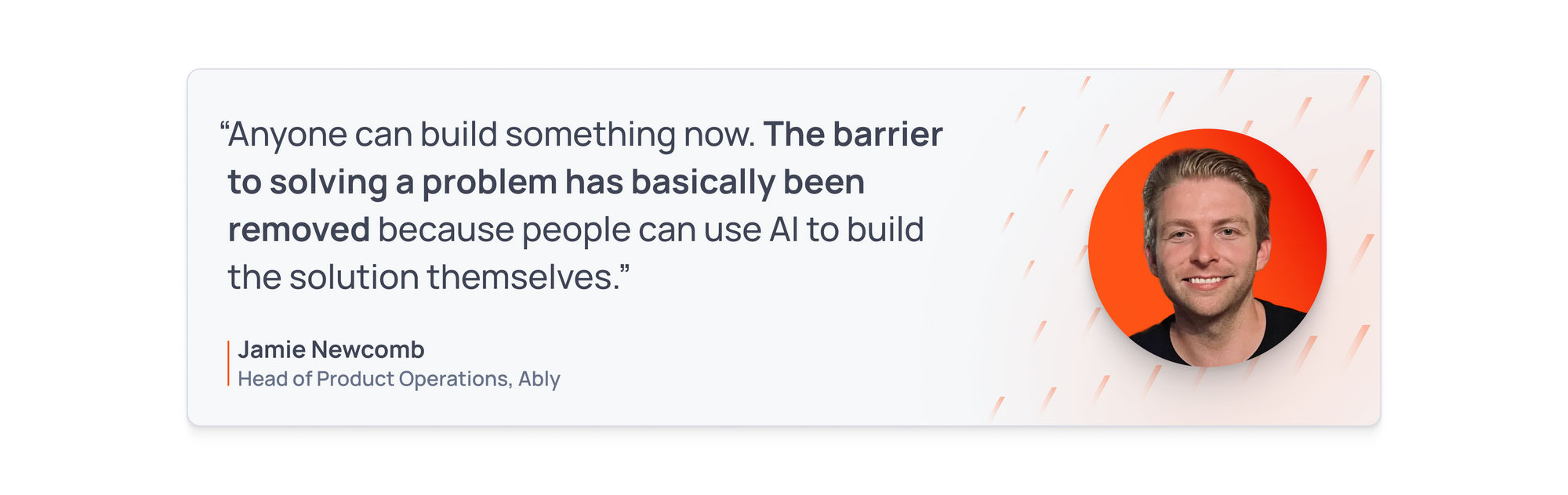
"Anyone can build something now," Jamie says. "The barrier to solving a problem has basically been removed because people can use AI to build the solution themselves."
The result is what Jamie calls the "wow moment": when someone successfully builds their first AI-powered solution, a ceiling lifts. "Once people have that moment, they just keep building."

What's next
But Jamie is candid about where Ably still has room to grow. "To be completely honest, we haven't hit our potential yet," he admits. "We've made real progress, but there's still more impact to unlock from AI across how we work, our processes, and how we achieve our product outcomes. And when we think we've got there, there'll still be more room to grow."
The vision for what's next is clear: continuing to integrate AI deeper into how Ably works. The foundations are in place: agentic coding, AI-assisted PR reviews, automated workflows across teams. But the true potential lies in making these the default across every function, not just the teams that adopted early.
"The biggest gains come from how people think, not just what tools they use," Jamie explains. "When people stop asking 'can AI help with this?' and start assuming it can, that's where the real impact comes from."
The most significant outcome isn't any specific tool or workflow, it's that cultural shift in action. "We don't have a problem at Ably where people are on the fence about whether AI can help them," Jamie reflects. "We've shown that it can. Now it's about enablement and encouraging people to identify problems they can solve themselves."
The same infrastructure philosophy that powers our internal AI adoption powers our AI Transport product. Read how Ably enables reliable, scalable realtime experiences for conversational AI here.