
Across AI infrastructure right now, one word is doing a lot of work: durable. It is attached to execution. To agents. To workflows. To sessions. To streams. To transports. To memory. And every few weeks, another product ships with "durable" in the name.
This is not branding noise. The underlying observation is the same in every case. AI systems are long-lived. They can fail at any layer. They need infrastructure that assumes failure rather than hopes against it. Different vendors are solving different slices, using different vocabulary, and converging on the same pattern.
In a recent post, I wrote about why Ably is betting on Durable Sessions as the infrastructure layer between agents and users. The question that came back from readers was straightforward: if the category is real, who else is in it? This post is the answer, along with our read on how the wider family of durable terms is taking shape.
Seven durable terms, three clusters
Seven distinct durable concepts are in active use across AI infrastructure. They group into three clusters, corresponding to where they sit relative to the agent.
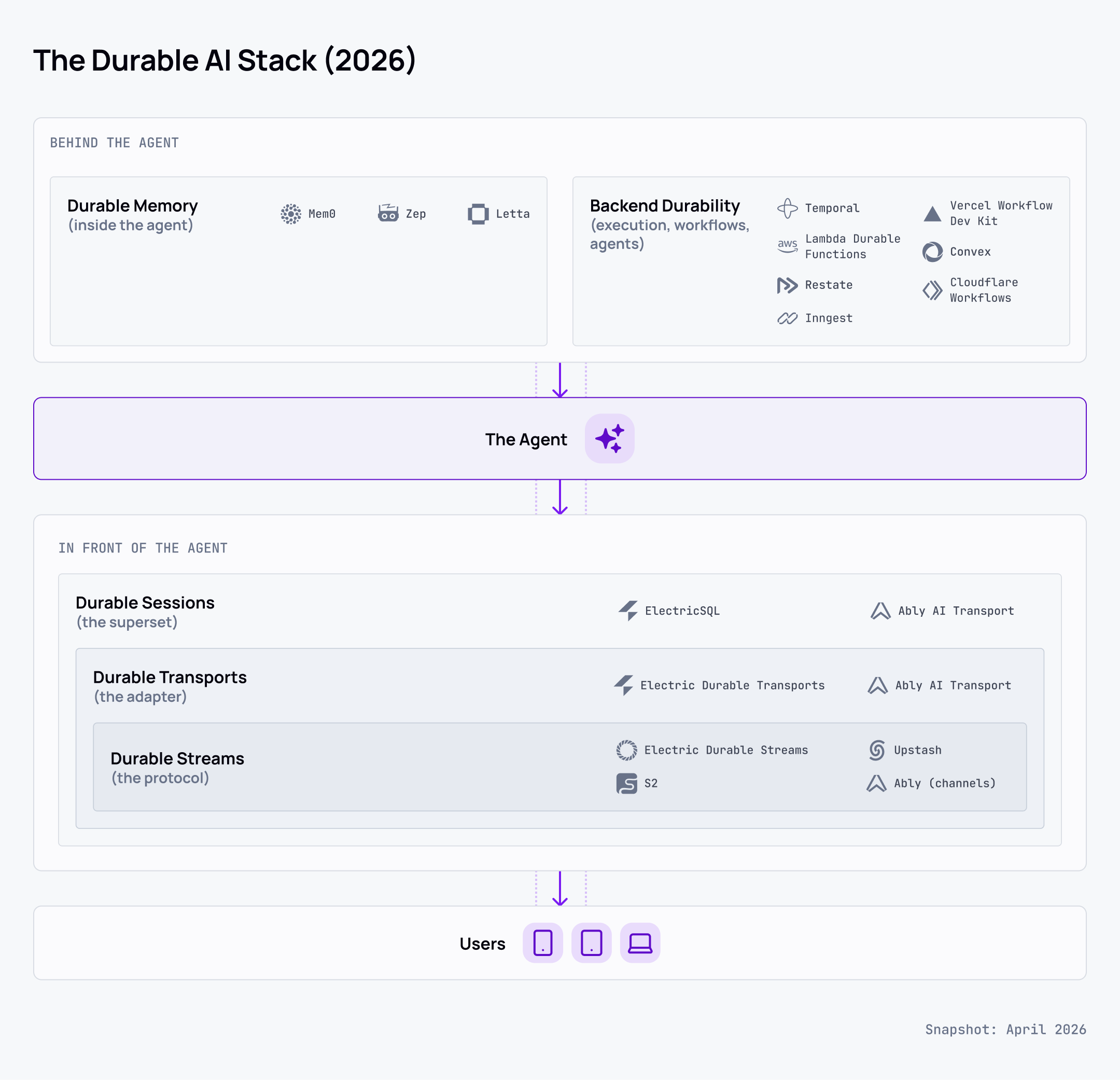
Behind the agent: memory. Durable Memory is persistent semantic recall that outlives a context window. The leading names here are Mem0, Zep, and Letta. Each takes a different approach to the same problem: giving agents a way to remember across sessions, tools, and conversations.
Behind the agent: backend durability (includes Durable Execution). This is a single problem area with three overlapping names. Temporal defined the category as Durable Execution and has since extended it to Durable Agents. AWS Lambda Durable Functions adopted the terminology at re:Invent 2025, which validated the category. Restate and Inngest Durable Functions sit in the same cluster. The Vercel Workflow Development Kit covers execution and agents in one kit. Convex uses Durable Workflows as its central term. Cloudflare Durable Objects and the Cloudflare Agents SDK cover the same space from the compute primitive side. Execution, workflows, and agents are not nested supersets. They are complementary angles on one goal: the agent's backend work survives crashes, retries, and multi-step orchestration.
In front of the agent: the session layer. This is where agents meet users. Three layers that build up in sequence.
- Durable Streams are the protocol primitive at the base. Resumable, replayable data streams that survive disconnects. ElectricSQL coined the term for AI and open-sourced a protocol with 1,400 stars on GitHub and clients in ten languages. S2 / StreamStore and Upstash are building on the same pattern. Ably sits in this tier as well. Channels have been our durable stream primitive for a decade. We simply did not market them that way.
- Durable Transports are the adapter layer. They plug a durable session into an AI framework's swappable transport slot, such as Vercel AI SDK's
ChatTransportor TanStack AI'sConnectionAdapter. ElectricSQL ships Durable Transports explicitly under that name. Ably's product is called AI Transport, and it provides a drop-in adapter for Vercel AI SDK that does what a durable transport is supposed to do. - Durable Sessions are what all of this adds up to. The pattern the user experiences. A session that survives disconnects, device switches, and agent crashes, built on streams and delivered through transports. Sessions are the superset: they bring in presence, shared state, offline delivery, human handover, and lifecycle management that the stream and transport layers on their own do not provide.
Samar Abbas of Temporal put the reference pattern well: when the world's largest cloud provider adopts your terminology, the debate is over. That is what has happened with Durable Execution. It is starting to happen across the other layers too.
The Durable Sessions club
The term Durable Sessions is not new. It has been a named feature of EMQX's MQTT broker for years, solving session persistence for IoT devices on unreliable networks. ElectricSQL picked it up for AI in January 2026. James Arthur's post defining Durable Sessions as a pattern for collaborative AI reached 75K views on X and drew hundreds of engaged replies. They followed with Durable Transports for Vercel AI SDK and TanStack AI in March. A Hacker News thread earlier this year titled "Disposable Environments, Durable Sessions: My Ideal Agentic Workflow" showed the phrase entering developer vocabulary organically.
ElectricSQL is approaching the category from the angle of state sync, Postgres replication, and structured state multiplexed over resumable HTTP. That is a coherent worldview, and it is what you would expect from a database company.
Ably is approaching it from a different angle. We are a realtime company. We have spent a decade on WebSocket-based infrastructure: bidirectional, stateful, long-lived connections that carry presence, order, and backpressure alongside the data. Channels are our primitive. They are persistent, ordered, and recoverable, with presence built in. Durable Sessions are a superset of channels. They combine the stream with presence, live collaborative state, mutable history, and push notifications for offline clients.
AI Transport is our implementation of the full session layer. It is a durable transport and a durable session, covering all three problem areas below.
When a database company and a realtime company arrive at similar definitions through entirely different histories, the thing they have arrived at is probably real.
What we mean by a durable session
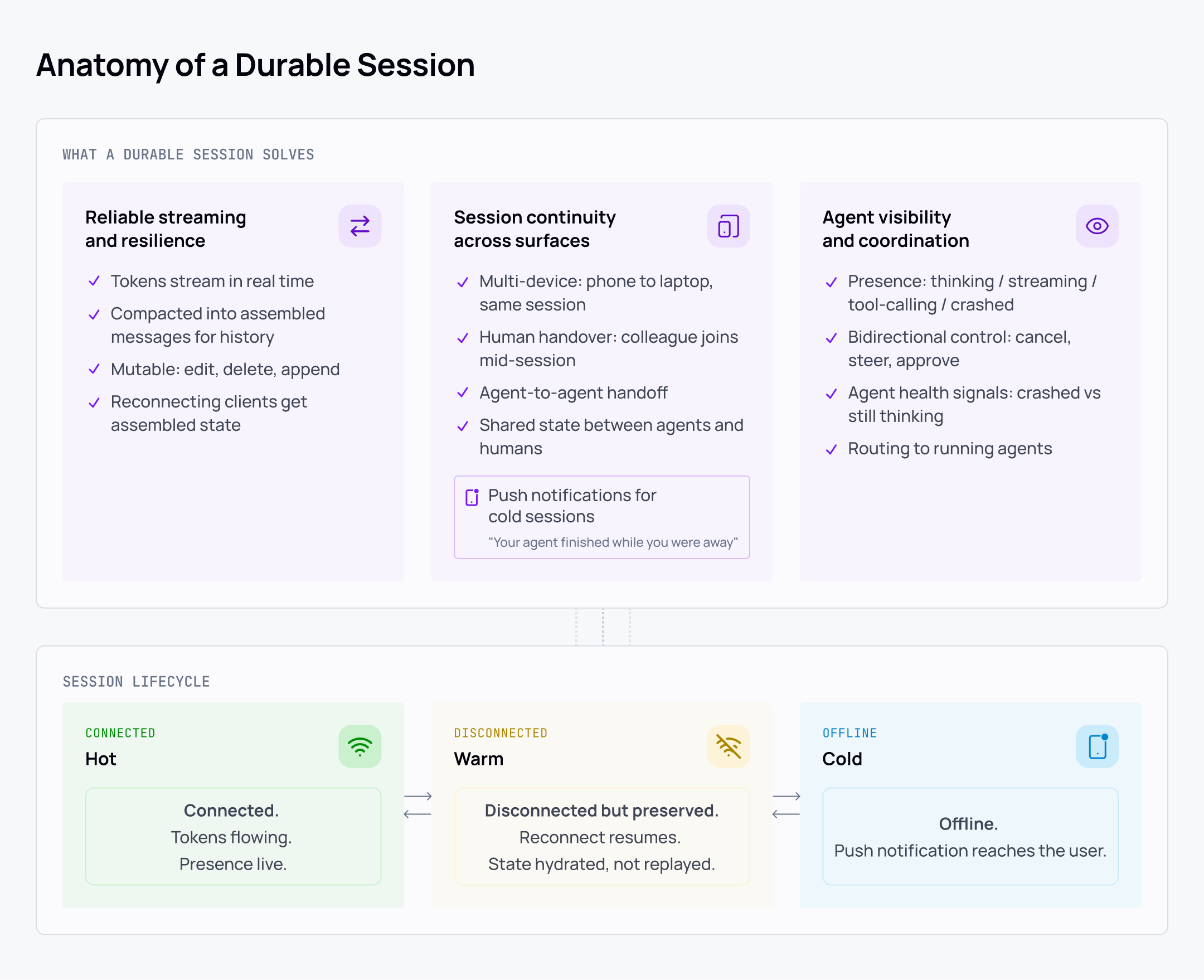
A durable session solves three problems, and all three must work across the session lifecycle.
Reliable streaming and resilience
A session must carry a stream of data from the agent to the user. Messages, tokens, and tool calls. Not every solution in the ecosystem does this reliably.
An AI response can be thousands of tokens. Tokens stream to the client in real time, one after another. Behind the scenes, Ably compacts those tokens into a single message that grows as the response assembles. History stays coherent. A reconnecting client does not replay thousands of individual token events; it asks for the assembled message.
The stream must also be mutable. When an agent crashes mid-response, the message needs to be correctable or retractable, not left half-rendered in history. Mutable streams were originally introduced for Ably's Chat product. They turned out to be exactly what AI sessions need.
Session continuity across surfaces
The conversation belongs to the user, not the browser tab. When the user closes a laptop and picks up a phone, the session follows. When they refresh mid-stream, tokens are not lost. When a human colleague joins the session, they see the full history and the current state. When the agent hands off to another agent, the new agent gets the context.
When the user has been offline long enough that the session has gone cold, push notifications reach them. "Your agent finished while you were away." Cold-state delivery is the capability most stream-layer solutions do not touch, because it requires infrastructure that extends beyond the stream itself.
Agent visibility and coordination
Presence is the signal layer. The session tells both sides whether the agent is thinking, streaming, tool-calling, or crashed, and whether the user is typing, idle, or gone. Bidirectional control covers cancel, steer, interrupt, and approve. Routing to running agents depends on knowing which agents are alive.
Without visibility, users stare at spinners and guess. With it, the product surfaces state accurately and the user can act on each state.
The lifecycle: hot, warm, cold
All three problem areas operate across three session states. Hot is active: connected, tokens flowing, presence live. Warm is disconnected but preserved: the client can reconnect and resume, with state hydrated rather than replayed. Cold is offline long enough that the session must reach the user asynchronously, via push notification.
A durable session reflects the conversation, not the log of what happened.
The log is what some of the stream-layer companies are building. It is useful. The session is what sits between the agent and what the user actually sees. That is where we think the source of truth needs to live.
The category is bigger than any one company
At Ably, we are committed to pushing Durable Sessions forward as a category, not as a product name we own. Every layer above, every vendor named in this post, is contributing to the same goal: making AI experiences reliable, consistent, and worth using.
We will keep contributing to the definition, keep publishing the pieces, keep making the technical case. Whether the layer eventually gets called Durable Sessions or something else, and whether Ably, ElectricSQL, or a company that has not shipped yet ends up being the name that sticks, what matters is that the layer exists and developers can reach for it.
An updated view of the durable ecosystem will be published at durablesessions.ai. A living map belongs somewhere neutral, not on any single company's blog.
If you are building in any of these layers, or evaluating AI Transport for what you are working on, reach out to me or the AI team.


